Hysterectomy: what the operation removes, what it changes, and what it does not change
This article is for informational purposes and does not replace a consultation. The decision to operate, the type of hysterectomy, and the surgical approach should be discussed with your gynecologist and surgeon based on your situation. The figures cited come from the sources listed at the bottom of the page.
No Smoon product treats or prevents any condition or replaces medical treatment. The underwear mentioned in this article is absorbent underwear, nothing more.
You have been offered a hysterectomy, or the word has just come up for the first time during a consultation. Between stories found online, opinions from those around you, and questions you did not think to ask at the time, it can be difficult to know exactly what the operation removes and what changes afterward.
Hysterectomy is the surgical removal of the uterus. That is precisely what it is, and nothing else: it does not systematically remove the ovaries, it does not automatically trigger menopause, and it is never the first treatment offered when the condition is benign.
Here is what Assurance Maladie, the French National College of Gynecologists and Obstetricians (CNGOF), and French hospital data say: the types of surgery, surgical approaches, the actual complication figures, the recovery timeline, and what really changes afterward.
Removing the uterus does not mean removing the ovaries. This is the most common misconception about the subject, and the one that causes the most concern.
- Definition: Assurance Maladie describes hysterectomy as a procedure that involves removing the uterus or part of it.
- Types: total (body and cervix), subtotal (the cervix remains in place), with salpingectomy or adnexectomy if the fallopian tubes and ovaries are removed at the same time.
- Surgical approaches: in France in 2019, laparoscopy 30%, laparotomy 29%, vaginal approach 26%, and laparoscopic-vaginal approach 15%.
- The numbers: nearly 60,000 hysterectomies in France in 2019, compared with approximately 72,000 in 2008. The decline followed the introduction of alternatives.
- The ovaries: if they remain, their function continues until natural menopause. If they are removed, the procedure causes menopause.
- Afterward: no more periods, pregnancy is no longer possible, bleeding for 1 to 2 weeks, and a clear recommendation from the CNGOF: use pads rather than tampons.
- Sexuality: the CNGOF states that hysterectomy affects neither the possibility nor the quality of sexual intercourse. Resumption 4 to 6 weeks afterward.
What is a hysterectomy?
Removal of the uterus, and only the uterus
The French National Health Insurance defines hysterectomy as “a radical treatment option that consists of removing the uterus or part of it.” The uterus is the organ that houses a pregnancy and whose inner lining, the endometrium, renews itself with each menstrual cycle. Removing it therefore ends periods and any possibility of pregnancy.
Everything else depends on what the surgeon removes in addition. The ovaries, fallopian tubes, and cervix are separate organs, each with its own function. If you are unclear about what does what, our glossary of the female reproductive system puts the pieces together in five minutes.
A common procedure, and one that is declining
A study published in 2021 in Gynécologie Obstétrique Fertilité & Sénologie, based on French hospital data, counted nearly 60,000 hysterectomies in France in 2019. Its authors describe it as the most common procedure among women.
The figure is falling: around 72,000 in 2008, 60,000 in 2019. The authors link this trend to the development of therapeutic alternatives for conditions that historically led to surgery. In other words, a hysterectomy proposed today is performed after other options have been ruled out.
What is removed and what remains
| Organ | Removed? | Consequence |
|---|---|---|
| Body of the uterus | Always | End of periods, end of the possibility of pregnancy |
| Cervix | Depending on the type | Removed in a total hysterectomy, left in place in a subtotal hysterectomy |
| Fallopian tubes | Often | A decision discussed on a case-by-case basis with the patient before the operation |
| Ovaries | Not systematically | If they are removed, the procedure causes menopause |
| Upper part of the vagina | Only in cancer surgery | Radical colpohysterectomy, reserved for cancer-related indications |
Slide the table to the left to see all the columns.
An adnexectomy, meaning removal of the fallopian tubes and ovaries, was performed alongside 41% of hysterectomies carried out in France in 2019. This is a separate decision from the hysterectomy itself and is discussed before the operation.
Total, subtotal, or radical: types of hysterectomy
Total hysterectomy
It is “the complete removal of the uterus,” body and cervix, according to the French National Health Insurance. This is the most common type for a benign condition. The top of the vagina is closed with absorbable sutures: this suture, called the vaginal scar, determines many of the recovery instructions.
Subtotal hysterectomy, when the cervix remains in place
Subtotal hysterectomy “involves removal of the body of the uterus while leaving the cervix in place.” It was long thought to be safer and better for sexual function. The 2015 CNGOF recommendations settled the matter, and the opposite is true.
- It is associated neither with fewer hemorrhagic or visceral complications nor with fewer transfusions, even though blood loss is reduced by 50 to 150 ml.
- It does not significantly improve sexual quality of life (level 1 evidence, the highest).
- It carries a risk of cyclical postoperative bleeding in 5 to 20% of cases, since uterine tissue remains at the level of the cervix.
- It leaves a risk of cancer in the remaining cervix, estimated at 0.2%.
CNGOF conclusion, grade B: performing a subtotal hysterectomy to reduce the risk of complications is not recommended. If your surgeon suggests it, there is a specific technical reason, and it is a good question to ask them.
Radical hysterectomy and associated procedures
In cervical cancer, Assurance Maladie describes a radical colpohysterectomy, “which consists of removing the entire uterus, the cervix, the fallopian tubes, and the upper part of the vagina,” often along with the ovaries and sometimes lymph node dissection. This is cancer surgery, entirely different from a hysterectomy for benign disease.
Regarding the ovaries, the CNGOF position is clear: in the absence of ovarian disease and personal or family history of breast or ovarian cancer, ovarian conservation is recommended in premenopausal women (grade B). Bilateral oophorectomy reduces the incidence of breast and ovarian cancers, but it leads to excess overall mortality from cardiovascular causes. The balance does not favor it when there is no reason to perform it.
Vaginal approach, laparoscopy, laparotomy: how the surgeon reaches the uterus
The four routes of access, and their actual share
The type of hysterectomy indicates what is removed. The route of access indicates how the surgeon reaches it. These are two separate decisions, and the second has a major impact on recovery. Distribution observed in France in 2019:
| Approach | Share | Scar | Hospital stay |
|---|---|---|---|
| Laparoscopy | 30 % | 2 to 3 incisions measuring 0.5 cm | 1 to 4 days, sometimes as an outpatient |
| Laparotomy | 29 % | Approximately 10 cm above the pubic bone | 4 to 7 days |
| Vaginal approach | 26 % | No skin incision | 1 to 4 days, sometimes as an outpatient |
| Laparoscopic-vaginal approach | 15 % | Small abdominal incisions | 1 to 4 days |
Slide the table to the left to see all the columns.
Assurance Maladie describes the vaginal route as “the least extensive”: it “begins with an incision around the cervix at the top of the vagina,” without opening the abdomen. Laparoscopy, “less invasive than laparotomy,” is performed using a camera inserted through small incisions.
What the CNGOF recommends
The 2015 recommendations are explicit: in the case of a hysterectomy for benign disease, the vaginal route or laparoscopy is recommended (grade B), “even if the uterus is large and/or the patient is obese” (grade C). The vaginal route is contraindicated neither in cases of nulliparity nor in cases of a previous cesarean section.
The choice between the two then depends on the surgeon’s experience, the type of anesthesia, and organizational constraints. A laparotomy is sometimes still necessary, and an operation planned through the vaginal route may be converted during the procedure: the CNGOF calls this a laparoconversion, and it is one of the possibilities explained beforehand.
How many hysterectomies does your surgeon perform?
This is the least spontaneous question and one of the most useful. The CNGOF recommends that a hysterectomy be performed by a surgeon who carries out at least 10 hysterectomies per year (grade C), and that a practitioner perform at least 30 during their training. Asking about the surgeon’s activity volume and the planned surgical approach is entirely reasonable and well received.
Why a hysterectomy is recommended
Benign indications
These are the most common. Assurance Maladie states that surgery becomes necessary when the uterine fibroid “causes hemorrhaging, very severe pain, or infertility.” The situations leading to a hysterectomy most often involve:
- Large or multiple uterine fibroids causing very heavy periods and sometimes iron-deficiency anemia.
- Adenomyosis, meaning the presence of endometrial-like tissue in the uterine muscle.
- Endometriosis that is painful and not controlled by medication, in some of its forms.
- Abnormal gynecological bleeding that does not respond to treatment, including bleeding between periods or significant blood clots.
- Genital prolapse, when the uterus descends and the resulting discomfort is disabling.
Cancer-related indications
Cervical, uterine, or ovarian cancer: surgery is then part of the treatment, and the type of procedure depends on the stage. For very small cervical tumors, Assurance Maladie specifies that “simple hysterectomy is rarely performed,” with more limited procedures such as conization or removal of the cervix being preferred. The decision is made by a multidisciplinary team, never by a single practitioner.
Why it is never the first treatment offered
For a benign condition, hysterectomy is the last resort. Assurance Maladie presents treatments for abnormal gynecological bleeding in a specific order: medication first, conservative procedures next, and removal of the uterus last. This hierarchy explains the decrease in the number of procedures since 2008.
Alternatives to hysterectomy
Drug treatments
First step, and often sufficient. Assurance Maladie lists tranexamic acid (Exacyl®, Spotof® and their generic versions), which is non-hormonal, followed by hormonal treatments: combined oral contraceptives, oral progestogens, and levonorgestrel intrauterine devices. The latter reduces bleeding while also providing contraception. Please note that hormonal treatment is contraceptive: it is not used if you wish to become pregnant.
Procedures that preserve the uterus
| Procedure | What it does | What it preserves |
|---|---|---|
| Endometrial ablation | Resection, ablation, or destruction of the endometrium | The uterus, but not fertility |
| Myomectomy | Removal of the fibroids alone | The uterus and the possibility of pregnancy |
| Embolization | Blocking the arteries that supply the fibroid | The uterus, without open surgery |
| Levonorgestrel intrauterine device | Reduces the thickness of the endometrium and bleeding | Everything, and it is reversible |
Slide the table to the left to see all the columns.
The right question to ask during a consultation
It can be summed up in one sentence: “What has been tried, and what remains to be tried before a hysterectomy?” A hysterectomy is irreversible. A second opinion, especially for a benign indication, is a right you can request without having to justify yourself. While you are making a decision, managing very heavy periods every day remains a real concern, and our menstrual panty comparison tool details the absorbency capacity of each model.
How the operation is performed
Beforehand: what is planned and what is not
A pre-anesthesia consultation is always required. The CNGOF recommends vaginal disinfection with povidone-iodine at the start of the procedure and antibiotic prophylaxis with a cephalosporin regardless of the surgical approach—two grade B recommendations. However, mechanical bowel preparation is not recommended: it does not improve anything, including visibility of the surgical field.
One point is emphasized in all three CNGOF patient information sheets: “Smoking increases the risk of surgical complications in any surgery. Stopping smoking 6–8 weeks before the procedure eliminates this additional risk.” This is the factor you have complete control over.
The day of surgery
- Hospital stayMost often, the day before or the day of the procedure.
- AnesthesiaUsually general anesthesia, sometimes regional anesthesia such as an epidural, depending on the surgical approach and your preference.
- ProcedureThe top of the vagina is closed with absorbable sutures. In laparoscopy, 2 or 3 incisions measuring 0.5 cm are closed with absorbable sutures. In laparotomy, the scar is approximately 10 cm long, horizontally above the pubic bone.
- Recovery roomPostoperative monitoring before returning to your room. A urinary catheter may be used for a few hours, sometimes 24.
- Getting up for the first timeCompression stockings, daily anticoagulant injections for up to around ten days, depending on the case, and ankle movements several times a day while you remain bedridden.
The first few days
The IV is removed as soon as you can drink and your bowels start working again. Digestion may be slowed, causing temporary discomfort: fruit and fiber can help prevent constipation. You may shower the next day after vaginal surgery, or as soon as you can stand after laparotomy, but baths should be avoided for 3 weeks. Regarding catheterization, the CNGOF is precise: after a hysterectomy, it recommends leaving the catheter in place for no more than 24 hours; beyond that, urinary tract infections increase significantly.
Risks and complications: the figures
What the literature says
The CNGOF describes hysterectomy as a “common and well-established procedure that is straightforward in most cases.” Complications do occur, but they are rare, and keeping them in mind helps you recognize a problem rather than imagine one.
| Complications | Prevalence | What to know |
|---|---|---|
| Bladder injury | 0.6 to 1% | Risk factors: previous cesarean section, enlarged uterus |
| Ureteral injury | 0.04 to 0.5% | Rarest complication of urinary tract injuries |
| Bowel injury | 0,5 % | More common after laparotomy |
| Vesicovaginal fistula | Approximately 0.1% | Risk increases to 5% if the bladder is injured during surgery |
| Cancer in the remaining cervix | 0,2 % | Only after subtotal hysterectomy |
Slide the table to the left to see all the columns.
One piece of good news that often goes unnoticed: CNGOF notes that hysterectomy is not associated with an increased prevalence of constipation, either in the short or long term. This is one of the most common concerns, but the data do not confirm it.
Signs that should prompt you to seek medical attention
CNGOF lists the symptoms that warrant contacting your primary care doctor or surgeon without waiting for the postoperative appointment:
- Pain in a calf or difficulty breathing. Quickly contact your primary care doctor to rule out phlebitis, which can lead to a pulmonary embolism.
- Abnormal or foul-smelling vaginal bleeding, high temperature. Possible infection or infected hematoma; your surgeon should assess this.
- Nausea, vomiting with an episode of fever. Also consult your surgeon.
- Burning when urinating, frequent urges. A urinary tract infection is possible; your primary care doctor will request a urine test.
- Red and painful scar after laparotomy, especially with a fever: hematoma or abscess, usually treated with simple local care.
If you are unsure how serious it is, call 15, available 24 hours a day.
Recovery, week by week
The actual timeline
This is the part that loved ones underestimate the most—and so do you. The guidelines below come from Assurance Maladie and CNGOF patient information sheets. They vary according to the surgical approach: recovery after vaginal surgery or laparoscopy “rarely exceeds 15 days,” whereas a laparotomy requires 4 to 6 weeks.
| Activity | Time frame | Details |
|---|---|---|
| Driving | 2 to 3 days after laparoscopy | 14 days after vaginal surgery, 21 days after laparotomy |
| Extended travel | 2 weeks | Car, train, or plane travel not recommended before |
| Lifting heavy objects | 3 weeks | Avoid lifting more than 5 kg |
| Baths | 3 weeks | Showers permitted much earlier |
| Sick leave | 2 weeks to 1 month | Depending on the surgical approach and your occupation |
| Walking, swimming | 2 to 3 weeks after laparotomy | 30- to 60-minute walk |
| Strenuous sports | 6 weeks after laparotomy | Gradual resumption |
| Sexual intercourse | 4 to 6 weeks | Until the vaginal scar is fully healed |
Slide the table to the left to see all the columns.
Fatigue, and how to get through it
The CNGOF warns: “You may still feel tired for a few days, or even 1 to 2 weeks,” due to stress and the effects of anesthesia. It adds a sentence that runs counter to intuition: “The faster you recover, the more active you are.” Walking a little every day is part of the treatment. Staying in bed is not.
Bleeding after a hysterectomy
One to two weeks is normal
The sentence appears identically in all three CNGOF information sheets: “You can expect to have bleeding for 1 to 2 weeks after your procedure. Passing small clots is not uncommon and is not a cause for concern if it does not last.”
This bleeding comes from the scar at the back of the vagina, not from menstruation: the uterus is no longer there. It gradually subsides, then gives way to lighter discharge. Bleeding that becomes heavier, develops an unpleasant odor, or is accompanied by fever falls outside the normal course and should be reported to the surgeon.
Pads rather than tampons, and why
The CNGOF is unequivocal in all three information sheets: “You are advised to use sanitary pads rather than tampons, which carry a higher risk of infection.”
The same principle applies to sexual intercourse: until the vaginal suture is strong, nothing should be inserted. This rules out tampons and menstrual cups, for the same reasons that make internal protection use delicate in other contexts. What remains: external protection.
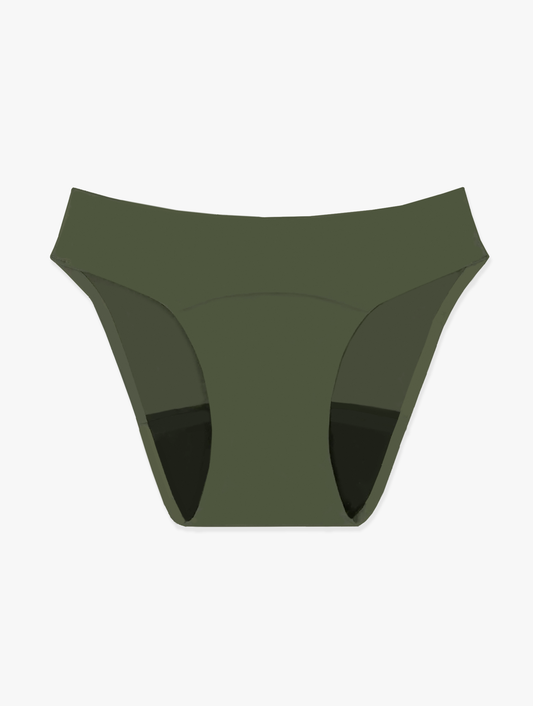
Period panties are one such option. They absorb into the underwear fabric without inserting anything, exactly like a sanitary pad, and are rinsed in cold water after wearing. Three criteria really matter during this period:
- The waist height. After a laparotomy, the scar is located approximately 10 cm above the pubic bone. A low-rise waistband sits over it. A high waist sits above it, following the same logic as post-C-section panties.
- The material against the skin. Cotton against healing skin, rather than a tight synthetic knit.
- The cut. A seamless style does not dig in or rub against a still-sensitive abdomen.


It does not treat anything, prevent any infection, or replace any instructions from your healthcare team. It is absorbent underwear, to be washed as such. Ask your surgeon what they recommend in your specific case, especially if a drain or packing has been left in place, or if your scar requires care.
Bleeding may return after a subtotal hysterectomy
This is the least-known consequence of this variation. Since the cervix is retained, hormone-responsive tissue remains, and the CNGOF estimates a 5 to 20% risk of cyclical postoperative bleeding. It is generally light and returns in line with the cycle, even though periods are supposed to have stopped. This is not a complication, but a known characteristic of the procedure, and it is better to learn about it beforehand. For this situation, the styles designed for light everyday leakage are usually sufficient.
Life after a hysterectomy
No more periods, but not necessarily menopause
This is the point the CNGOF takes care to state explicitly in its patient information sheets. If you were not menopausal before the procedure, “the main effects will be the absence of periods and the inability to become pregnant, which does not mean that you will be menopausal.”
If you were already menopausal before the operation, the CNGOF states that “there will be no particular changes afterward.” And if your ovaries were removed, the guidance on menopause and the lifestyle that accompanies it still applies, except that everything happens all at once rather than developing over several years.
Sexuality after a hysterectomy
The CNGOF statement is unambiguous: “In all cases, a hysterectomy does not affect the possibility or quality of sexual intercourse.” Intercourse is permitted 4 to 6 weeks after the procedure, once the vaginal scar is sufficiently strong, and resuming sexual activity is ideally discussed at the one-month postoperative appointment.
One point is worth anticipating rather than simply enduring: “If your ovaries have been removed, you may experience vaginal dryness, which could be relieved with lubricants or hormone replacement therapy prescribed by your doctor.” This is neither inevitable nor something you should keep to yourself.
Cervical screening: what changes
A practical consequence that few women know about. The French National Cancer Institute puts it this way: “If you have had a total hysterectomy (removal of the uterus and cervix) unrelated to cervical cancer, you no longer need cervical cancer screening.”
Two important nuances. After a subtotal hysterectomy, the cervix is still present, so screening continues. After a hysterectomy related to cancer, specific follow-up replaces screening: it is more frequent, not less thorough. In all cases, the rest of your gynecological care does not stop.
The pelvic floor and urinary leakage
The pelvic floor, this hammock of muscles supporting the bladder and rectum, remains in place after a hysterectomy. The CNGOF also specifies that no preventive prolapse procedure is routinely recommended during a hysterectomy on a non-prolapsed uterus.
This does not mean that it should not be cared for, particularly after the age of fifty, when declining estrogen levels also play a role. If urinary leakage appears or worsens, it should be reported to a doctor rather than simply accepted: pelvic floor rehabilitation with a physiotherapist or midwife remains the first-line response, and Kegel exercises can extend it at home. In everyday life, our support panties that reduce urinary leakage during physical exertion, registered as a medical device, can be worn alongside medical care, never as a substitute for it.
The psychological impact we are reluctant to name
Removing a uterus is not like removing a gallbladder. The organ carries personal and social meaning, and reactions range from clear relief—especially after years of pain or heavy bleeding—to a feeling of loss, sometimes both in the same week.
None of these reactions is abnormal, and none is proportional to the severity of the condition treated surgically. When mourning fertility is part of the experience, it does not depend on age or the number of children. If the subject feels overwhelming, speaking with your gynecologist, primary care physician, or a psychologist is part of the care journey, both before and after the operation. The CNGOF materials express this in their own way by encouraging patients to ask all their questions “orally or in writing,” including those that are not technical.
Frequently asked questions about hysterectomy
-
01What exactly is a hysterectomy?
It is the surgical removal of the uterus. Assurance Maladie describes it as a radical treatment option involving removal of the uterus or part of it. It ends menstruation and eliminates the possibility of pregnancy. It does not systematically remove the ovaries, fallopian tubes, or cervix: these are separate procedures, decided on a case-by-case basis and discussed with the surgeon before the operation. Nearly 60,000 hysterectomies were performed in France in 2019, compared with approximately 72,000 in 2008.
-
02What are the different types of hysterectomy?
Assurance Maladie distinguishes three types. Subtotal hysterectomy involves removing the body of the uterus while leaving the cervix in place. Total hysterectomy involves completely removing the uterus, including the body and cervix. Total hysterectomy with salpingectomy also removes the fallopian tubes, while with adnexectomy it removes the fallopian tubes and ovaries. For cervical cancer, radical hysterectomy additionally removes the upper part of the vagina, sometimes along with lymph node dissection.
-
03Does a hysterectomy cause menopause?
Not in itself. The CNGOF states that if the ovaries are left in place, their function will continue until natural menopause, without hot flashes or other menopausal symptoms. However, if the ovaries are removed, the procedure causes menopause, with symptoms such as hot flashes, and the possibility of hormone replacement therapy should be discussed with a doctor. The CNGOF also recommends preserving the ovaries in women who have not reached menopause when there is no ovarian disease or personal or family history of breast or ovarian cancer.
-
04How long does recovery take after a hysterectomy?
This depends mainly on the surgical approach. After a vaginal procedure or laparoscopy, the CNGOF indicates that recovery rarely exceeds 15 days, with a hospital stay of 1 to 4 days or possibly outpatient care. After a laparotomy, the hospital stay generally lasts 4 to 7 days, and returning to work or sports takes 4 to 6 weeks. The French National Health Insurance system mentions sick leave generally lasting from 2 weeks to 1 month. Fatigue during the first 1 to 2 weeks is expected, and recovery is faster the more active you remain.
-
05Is there bleeding after a hysterectomy, and what protection should be used?
Yes. The CNGOF states that you can expect bleeding for 1 to 2 weeks after the procedure, and that passing small clots is not uncommon and is not concerning if it does not continue. Regarding menstrual protection, the guidance is explicit: sanitary pads are recommended rather than tampons, which would entail a greater risk of infection until the vaginal incision has healed firmly. Any external protection meets this guidance, including period underwear, which absorbs the blood into the fabric of the underwear without inserting anything. Bleeding that becomes heavier, develops an unpleasant odor, or is accompanied by fever should be reported to the surgeon.
-
06What are the risks of a hysterectomy?
The CNGOF describes it as a common, well-established procedure whose course is straightforward in most cases. For a benign indication, the prevalence of bladder injuries is 0.6 to 1%, ureteral injuries 0.04 to 0.5%, digestive-tract injuries 0.5%, and vesicovaginal fistulas approximately 0.1%. A history of cesarean delivery and an enlarged uterus are the two identified risk factors for bladder injuries. As with any surgery, the procedure may, in very exceptional cases, carry a life-threatening risk. Conversely, hysterectomy is not associated with an increased prevalence of constipation, either in the short or long term.
-
07Are there alternatives to a hysterectomy?
Yes, and for a benign condition, they come first. The French National Health Insurance system first lists drug treatments: tranexamic acid, combined oral contraceptive pills, oral progestins, and a levonorgestrel-releasing intrauterine device. Next come procedures that preserve the uterus: endometrial resection or ablation, myomectomy to remove fibroids alone, and uterine artery embolization. The decline in the number of hysterectomies in France between 2008 and 2019 is precisely correlated with the development of these alternatives. Asking what has been tried and what remains to be tried is a legitimate question during a consultation.
-
08Does a hysterectomy affect sexuality?
CNGOF states that in all cases, hysterectomy does not affect the possibility or quality of sexual intercourse. Intercourse is permitted 4 to 6 weeks after the procedure, to allow the vaginal incision to become sufficiently strong, and it is recommended to wait until the one-month postoperative visit to discuss it. If the ovaries have been removed, vaginal dryness may occur, which can be relieved with lubricants or hormone replacement therapy prescribed by a doctor. It should be noted that subtotal hysterectomy, long considered preferable in this regard, is not associated with a significant improvement in sexual quality of life.
-
09Should cervical cancer screening continue after a hysterectomy?
It depends on the type of procedure. The French National Cancer Institute states that if you have had a total hysterectomy, with the uterus and cervix removed, unrelated to cervical cancer, you no longer need cervical cancer screening. After a subtotal hysterectomy, the cervix is retained and screening continues. After a procedure related to cancer, specific follow-up replaces screening. In all cases, the rest of your gynecological care continues.
-
10Can you still have periods after a subtotal hysterectomy?
Not periods in the strict sense, since the body of the uterus has been removed, but bleeding can occur. CNGOF estimates a 5 to 20% risk of cyclical postoperative bleeding after a subtotal hysterectomy because hormone-responsive tissue remains in the retained cervix. This bleeding is generally light and follows the rhythm of the cycle. It is not a complication but a known characteristic of this variant, and it is one of the reasons why CNGOF does not recommend performing a subtotal hysterectomy solely to reduce complications.
- Assurance Maladie, Treatment of a uterine fibroid, definition of hysterectomy, subtotal and total types and hysterectomy with adnexectomy, surgical approaches, conservative alternatives.
- Assurance Maladie, Uterine fibroid: postoperative follow-up, time before resuming driving, sports, travel, lifting, work, and sexual intercourse.
- Assurance Maladie, Abnormal gynecological bleeding: what are the treatments?, hierarchy of drug and surgical treatments.
- Health Insurance, Treatment of cervical cancer, conization, cervical amputation, radical trachelectomy, lymph node dissection.
- CNGOF, Hysterectomy for benign disease, clinical practice guidelines, 2015, short version. Surgical approach, ovarian preservation, subtotal hysterectomy, prevalence of urinary and digestive tract injuries, surgeon’s activity volume.
- CNGOF, patient information sheets, 2017: vaginal hysterectomy, laparoscopic hysterectomy and abdominal hysterectomy. Procedure, length of hospital stay, postoperative bleeding, recommended protection, menopause, sexuality, warning signs.
- National Cancer Institute, Cervical cancer screening: are you concerned?, status of women who have undergone a total hysterectomy.
- Chevrot A, Margueritte F, Fritel X, Serfaty A, Huchon C, Fauconnier A, Hysterectomy: changes in practice between 2009 and 2019 in France, Gynecology Obstetrics Fertility & Senology, 2021, 49(11), 816-822. Annual volume, distribution by surgical approach, proportion of adnexectomy procedures.