Retroverted uterus: what it really changes in daily life
This article is informative and does not replace a consultation. A retroverted uterus is diagnosed during a gynecological exam, not from an article or an online test. If pain bothers you daily, talk to a healthcare professional.
The phrase often comes up during an ultrasound: “you have a retroverted uterus.” Said without explanation, it worries many women who leave imagining a problem to watch. It is not one.
A retroverted uterus is simply a uterus tilted backward rather than forward. It is an anatomical variant, just like being left-handed. About one in four women is affected, most without knowing it, and without it changing anything about their fertility. Here is what it really means, and the rare situations that deserve medical advice.
A retroverted uterus is not a disease. It is an anatomical position, present in about 20 to 30% of women.
- The difference: the uterus tilts backward, towards the rectum, instead of resting forward on the bladder.
- Symptoms: most often none. Sometimes pain during sexual intercourse in certain positions, or pelvic and lower back pain during menstruation.
- Fertility: no impact. The position of the uterus does not prevent fertilization or implantation.
- Pregnancy: the uterus straightens spontaneously, usually around 12 to 14 weeks.
- Treatment: none when there are no symptoms. What is treated, if necessary, is the cause when retroversion is acquired.
- To check: a retroversion that appears with new pain may indicate endometriosis or a fibroid and deserves an evaluation.
What is a retroverted uterus
Anteversion and retroversion, two possible orientations
The uterus is not rigidly fixed in the pelvis. It is held by ligaments that allow it some freedom, so it can orient itself in several ways.
The MSD Manual, in its edition for professionals, summarizes it in a sentence that should be posted in all waiting rooms: "Different degrees of flexion are normal." The book specifies that the uterus can be oriented forward or backward at different angles, and it can also have anterior or posterior flexion.
How many women have a retroverted uterus
Estimates range around 20 to 30% of women, with the most commonly cited figure being one quarter. In other words, in a group of eight friends, two probably have a retroverted uterus, and there is a good chance that neither of them knows it.
The MSD Manual provides an interesting detail: women who have given birth often have a retroflexed uterus. Childbirth changes the support of the ligaments, and the position can evolve over life.
Causes of a retroverted uterus
The congenital cause, by far the most frequent
In the vast majority of cases, there is no cause to look for. The uterus simply positioned itself this way, as it could have positioned otherwise. This configuration has been present since always, and it requires no further explanation.
Acquired causes
More rarely, retroversion appears during life. It then becomes a sign rather than a characteristic, and the underlying cause is what matters.
- Pregnancy and childbirth, which relax the uterine ligaments.
- Endometriosis, whose lesions and adhesions can tilt the uterus backward.
- Uterine fibroids, depending on their size and location. These are common benign tumors, which we detail in our article on blood clots during menstruation.
- Adhesions, sequelae of pelvic surgery or upper genital infection.
A retroverted uterus that has always been present and without symptoms requires no action. A retroverted uterus recently diagnosed and accompanied by new pain deserves an evaluation, not because of its position, but because the position may indicate something else. This nuance is missing from most articles on the subject.
Symptoms of a retroverted uterus
Most often, none
This is the main point to remember first. The majority of affected women feel absolutely nothing and discover their retroverted uterus by chance during a routine gynecological exam or a pregnancy ultrasound.
When symptoms exist, they are generally mild and intermittent. Two of them regularly come up in what women describe to their gynecologist.
Pain during sexual intercourse
This is the most frequently reported symptom. Since the cervix is oriented differently, deep penetration can hit it in certain positions and cause a dull pain, usually toward the end of intercourse.
Nothing inevitable: it’s a matter of angle, and changing position is often enough. However, pain during sexual intercourse that persists regardless of position is not explained by retroversion alone. Our article I have pain during sex reviews other possible causes, which deserve to be explored.
Pelvic and lower back pain during periods
Some women describe pelvic pain and more pronounced lower back discomfort during periods, with the contracted uterus pressing backward. Pressure on the bladder or rectum is also sometimes reported.
| Symptom | Link with retroversion | To do |
|---|---|---|
| No symptoms | Most common case | None |
| Pain during deep penetration, depending on position | Plausible explanation | Adjust positions, discuss if it persists |
| Lower back discomfort during periods | Possible explanation | Heat, simple painkiller if needed |
| Very painful or very heavy periods | Not explained by position alone | Consult, investigate endometriosis or fibroids |
| Difficulty conceiving | No established link | Standard fertility assessment |
| Recurrent urinary infections | No proven link | Consult for a dedicated opinion |
Slide the table horizontally.
If your periods are painful or heavy enough to affect your daily life, don’t blame it on the position of your uterus. Our articles on period pain and on heavy periods provide guidelines on when to consult a doctor.
How to know if you have a retroverted uterus
Gynecological examination
There is no test to do at home, and no symptom alone can lead to a conclusion. It is the gynecologist, doctor, or midwife who identifies the position during the pelvic exam by bimanual palpation: two fingers in the vagina, the other hand on the lower abdomen, which allows assessing the size, position, consistency, and mobility of the uterus.
Pelvic ultrasound
This is the examination that confirms it. Ultrasound directly visualizes the orientation of the uterus and also helps rule out fibroids or signs of endometriosis. In fact, it is often during this examination that the discovery is made, even if the exam was not requested for that purpose. A pelvic MRI is only useful in specific contexts, not to confirm retroversion.
Retroverted uterus and fertility
No impact on the ability to conceive
This is the most common question, and the answer is clear. A retroverted uterus does not affect fertility. Sperm travel up without difficulty, fertilization occurs normally in the fallopian tube, and the embryo implants in the uterine lining regardless of the organ’s tilt.
This belief is persistent, probably because the announcement of an anatomical peculiarity naturally causes concern. No IVF or assisted reproduction procedure is justified by an isolated retroversion.
What to check in case of difficulty conceiving
If you have trouble conceiving, the problem lies elsewhere, and this is where the nuance mentioned earlier becomes very important. An acquired retroversion can accompany endometriosis or adhesions, and it is these conditions that can hinder conception. Depending on their location, the different forms of endometriosis have different consequences.
The right reflex is therefore not to worry about the position of the uterus, but to request a standard fertility assessment that will look for the real causes.
Retroverted uterus and pregnancy
The uterus straightens on its own
During the first trimester, the uterus grows and rests in the pelvis. After reaching a certain size, it no longer has room to remain tilted backward: it straightens spontaneously, usually between 12 and 14 weeks. No action is necessary.
Some women feel discomfort in the lower back or pressure on the bladder and rectum, sometimes with bowel transit issues. These sensations disappear once the uterus straightens.
Uterine incarceration, the only complication to be aware of
There is a rare situation where the uterus cannot straighten and remains stuck in the pelvis. This is called uterine incarceration. It occurs in about 1 pregnancy out of 3,000, most often between 14 and 16 weeks, and it is very well managed when detected early.
- Difficulty urinating or urinary retention, especially if it recurs.
- Severe pelvic pain or a strong pressure sensation in the rectum.
- An unusual and persistent constipation associated with the previous signs.
These signs are not trivial around the fourth month. They justify calling the maternity ward or the midwife who is following you, without waiting for the next appointment.
What treatments exist
In most cases, none
An anatomical variant is not treated. There is nothing to correct, nothing to monitor, and no reason for regular exams if all is well. This is probably the most useful information in this article.
If your gynecologist said nothing after mentioning retroversion, it’s precisely because there was nothing to add. Lack of follow-up is not an oversight; it’s the normal approach.
When treatment is justified
What is treated is the discomfort or the cause, never the position itself.
- If retroversion is confirmed: treatment targets the cause, such as endometriosis or fibroids, not the tilt.
- If pain during intercourse is truly disabling: support through perineal physiotherapy or sexology often helps more than surgery.
- Repositioning surgery exists but remains exceptional, reserved for severe symptomatic cases and after ruling out other explanations.
Living with it daily
Period protections, the question of angle
It’s a topic rarely discussed but often comes up. Since the cervix is oriented differently, inserting a tampon or a cup may require an unusual angle. However, the position of the cervix does not affect the cervical mucus it produces or its variations throughout the cycle. Some women find insertion more delicate or feel discomfort once the protection is in place. Our guide on how to insert a cup explains how to adjust the angle.
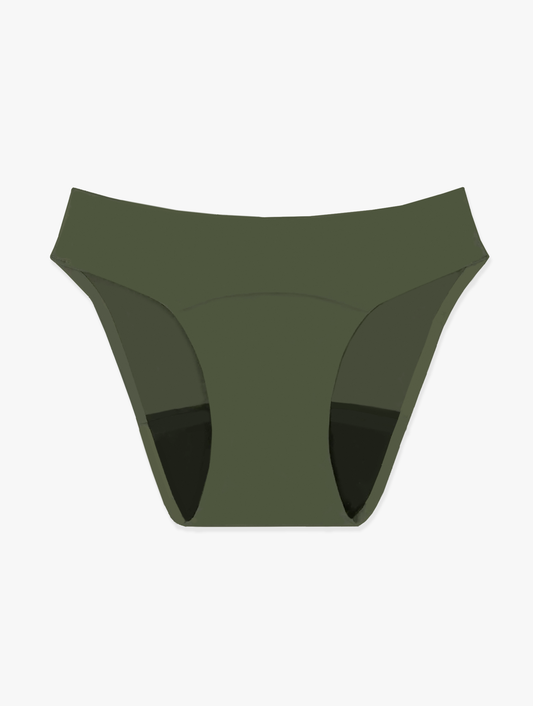
The other option is simply to remove the question. External protection does not insert, so the position of the cervix does not come into play. This is the most concrete reason why concerned women switch to menstrual panties.
 High waist
 More coverage
 Best-seller
Useful clarification: a menstrual panty does not change the position of the uterus and does not treat anything. It simply avoids the hassle of insertion, which is a real comfort when the angle of the cervix complicates the use of a tampon or cup.
Positions, IUD, and small adjustments
- During intercourse: positions where you control the depth, such as being on top, help avoid uncomfortable stops.
- For the insertion of an intrauterine device: inform the practitioner about the retroversion. The procedure is still entirely feasible; it just requires adjusting the angle.
- During menstruation: heat on the lower back often relieves better than on the belly when the discomfort is lumbar. If you are still unsure about the different protections, our guide on which hygienic protection to choose compares them one by one.
- During any gynecological exam: mention it, this avoids unnecessary manipulations.
Frequently asked questions
-
01What exactly is a retroverted uterus?
It is a uterus tilted backward, toward the rectum, instead of tipping forward and resting on the bladder as in most women. It is an anatomical variant, not a disease. The MSD Manual states that different degrees of flexion are normal. About 20 to 30% of women are affected.
-
02What are the symptoms of a retroverted uterus?
Most often, no. Some women report pain during deep penetration depending on the position, pelvic or lower back pain during menstruation, or a sensation of pressure on the bladder or rectum. Very painful or heavy periods are not explained by the position of the uterus and warrant medical advice.
-
03Does a retroverted uterus affect fertility?
No. The position of the uterus does not prevent sperm from traveling upward, fertilization, or embryo implantation. An isolated retroversion does not justify any assisted reproductive technology or IVF procedures. However, if the retroversion is acquired and linked to endometriosis or adhesions, these causes may hinder conception and should be investigated.
-
04Can you be pregnant with a retroverted uterus?
Yes, without any particular difficulty. During the first trimester, the uterus enlarges and spontaneously straightens, usually between 12 and 14 weeks. No action is necessary. Lower back discomfort or pressure on the bladder may be felt until then, then disappears.
-
05How to know if you have a retroverted uterus?
There is no self-test. The position is determined during a gynecological exam by bimanual palpation and confirmed by pelvic ultrasound. This exam also rules out fibroids or signs of endometriosis. The finding is often incidental during a routine check-up or pregnancy ultrasound.
-
06What treatments exist for a retroverted uterus?
None is necessary in the absence of symptoms, as it is not a pathology. When retroversion is acquired, the cause is treated, such as endometriosis or fibroids. In cases of disabling pain during intercourse, pelvic floor physical therapy and sex therapy are often more helpful than surgery. Repositioning surgery remains exceptional.
-
07When should you see a specialist?
See a doctor if pain during intercourse persists regardless of position, if your periods are very painful or heavy, if a retroversion has just been diagnosed along with new symptoms, or if you have difficulty conceiving. During pregnancy, difficulty urinating or urinary retention around the fourth month warrants immediate medical attention.
-
08Do tampons or cups cause problems with a retroverted uterus?
They remain usable, but the insertion angle differs since the cervix is oriented differently. Some women find insertion more delicate or feel discomfort once the protection is in place. Tilting further backward generally helps. An external protection like menstrual panties completely eliminates the issue, as there is nothing to insert.
- MSD Manual, professional edition, Pelvic exam, on uterine positions and evaluation by bimanual palpation.
- Data on the frequency of uterine incarceration from obstetric literature, estimated at about 1 pregnancy in 3,000.